|
|
 |
Powder Details

 |
IA1060
|
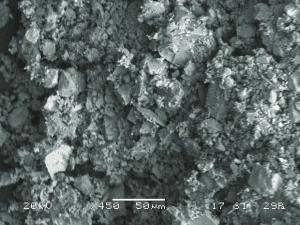
Alumina Powder, Irregular Shape, IA1060 (60 - 100 mesh)
Although majority of alumina is consumed for the production of aluminium, there is a wide range of specialty aluminas for non-metallic applications. Due to its physical and chemical properties, aluminum oxide plays an important role as an essential raw material for many market applications.
Aluminum oxide is highly heat resistance (fusion point 2050�C (3725�F)) and is an excellent insulator in refractories.
Its hardness and strength makes it suitable for use as an abrasive for polishing and as a component in cutting tools. It is widely used as a coarse or fine abrasive, including as a much less expensive substitute for industrial diamond.
Aluminum oxide adds great mechanical strength, has excellent resistance to corrosion and wear, and is a nontoxic material for ceramics.
Alumina is a medium for chemical chromatography. Large tonnages are also used in the manufacture of zeolites, coating titania pigments, and as a fire retardant/smoke suppressant.
Being fairly chemically inert, relatively non-toxic, and white, alumina is a favored filler for plastics, also a thermal conductive filler in adhesives. Alumina is a common ingredient in sunscreen.
As a catalyst and catalyst support, alumina catalyses a variety of reactions that are useful industrially. In its largest scale application, alumina is the catalyst in the Claus process for converting hydrogen sulfide waste gases into elemental sulfur in refineries. It is also useful for dehydration of alcohols to alkenes.
Alumina serves as a catalyst support for many industrial catalysts, such as those used in hydrodesulfurization and some Ziegler-Natta polymerizations. Zeolites are produced from alumina.
Alumina is also used as gas purification and related absorption applications. It is widely used to remove water from gas streams. |
|
|
|