Calcinated Alumina Powder 5 um, Levigated
A 98% alumina powder of approximately 5 microns average particle size with 95% finer than 10 microns. Used in polishing and buffing compounds, heat sink additives, thermal conductivity/electrical resistant coatings, and as an abrasion resistant coating (metals) or additive (plastics, epoxies, laminates).
Typical Physical Characteristics
Typical Chemical Composition
Crystal Form
Monocrystalline Alpha Alumina
Al2O3
98.70% min.
Shape
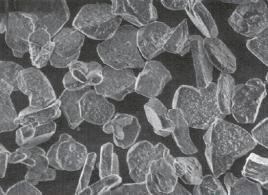
Hexagonal Platelets
SiO2
0.06% max.
Hardness
Knoop 2000
Fe2O3
0.03% max.
pH
9.0-10.5
Na2O
1.00% max.
Specific Gravity
3.95 gm/cc
TiO2
0.02% max.
-
-
CaO
0.07% max.
-
-
MgO
0.05% max.
Calcined alumina grains are normally composed of single platey crystals, whereas fused aluminum oxide grains tend to be fractions of large crystals and blocky in shape. A calcined crystal is theoretically a six-sided disc with a thickness of about one fifth of its diameter. This will vary from one type of crude to another but remains fairly consistent for any given type of calcined alumina.
The measurement of the diameter of the particle is referred to as the materials ultimate crystal size. The crude alumina is composed of aggregates of crystals which are broken up in a milling process to produce a material of individual crystals in the ultimate crystal size.
Calcined aluminas are more pure than fused aluminum oxide products with the exception of fused white aluminum oxide (both over 99% Al2O3). Calcined aluminas, when milled, retain the chemistry of the unmilled crude more closely than fused aluminum oxide. For example, dark fused aluminum oxide crude (typically 96% Al2O3) when processed into lapping powder sizes, will typically lose several percentage points of Al2O3. This is because the impurities in the crude are more easily crushed and migrate into the fine powder sizes.